

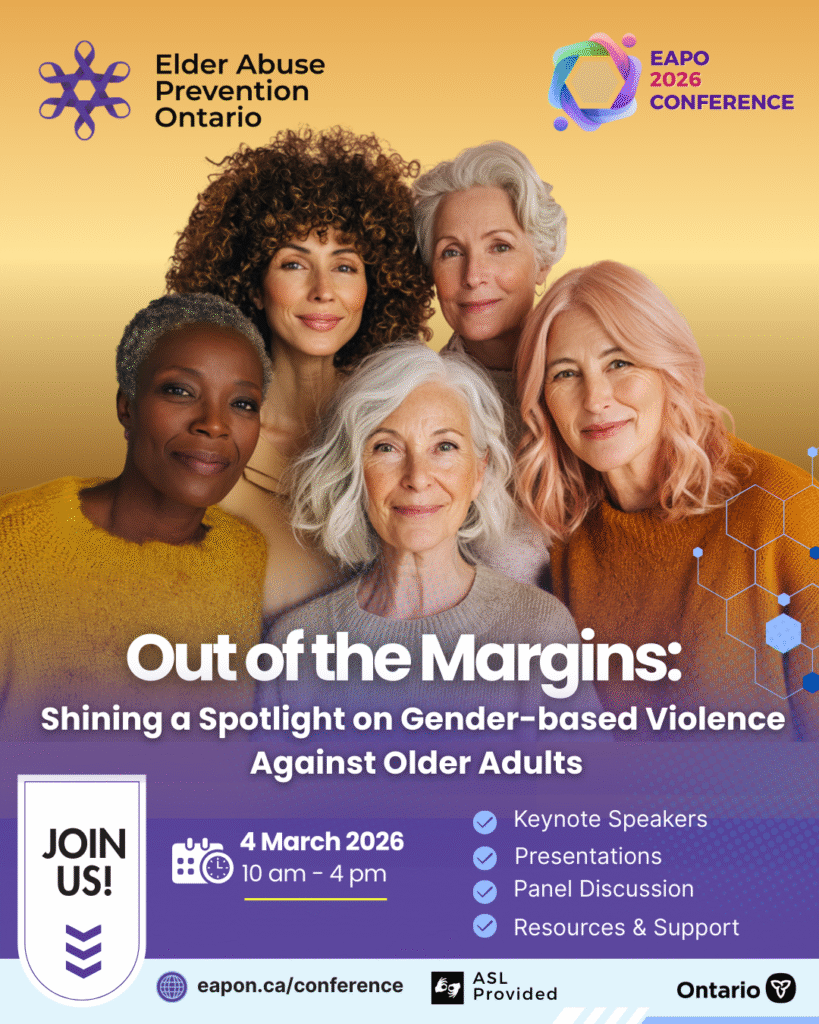
Virtual Conference 2026
Out of the Margins: Shining a Spotlight on Gender-based Violence
Against Older Adults
Wednesday, March 4th 2026
10:00 am – 4:00 pm (ET)
On March 4th, join EAPO for our virtual conference to address gender-based violence and IPV against older adults that brings together advocates and experts to explore meaningful solutions for GBV against older adults.
This conference aims to:
 Raise awareness of risk factors, and trends related to gender-based violence including coercive control.
Inform professionals supporting older adults on approaches to improve safety and support for aging individuals experiencing intimate partner violence.
Provide practical approaches for early identification, documentation, and intervention using trauma-informed best practices, to support older adults experiencing Intimate partner violence /gender-based violence.
Introduce a structured threat assessment and management framework to examine pathways to violence.
Highlight the intersection of animal abuse, gender‑based violence, elder abuse, and self‑neglect in later life and considerations for responding and supporting older adults and their companion animals.
Review privacy laws, legislation and guidelines for professionals to share information in situations when an older adult is at-risk of serious harm.
This event will be of interest to professionals supporting older adults.
Don’t miss this opportunity to expand your knowledge and make a difference in protecting older adults!
Reserve your spot today!
No charge to attend, but pre-registration required!
Attend the full conference event or join anytime during the day.
AGENDA
10:00 – 10:15 am Opening Remarks
Speakers :
Raeann Rideout, Director, Strategic Partnerships, EAPO
Marta Hajek, CEO, EAPO
KEYNOTE SPEAKERS AND PRESENTATION
10:15 – 11:30 am
DVDRC Learnings on Intimate Partner Homicide in Older Adults: Trends, Themes, and the Ryan & Ryan Inquest
This presentation explores emerging insights into intimate partner homicide (IPH) in older adults, drawing on findings from the Domestic Violence Death Review Committee’s 2022–2023 Annual Report. Trends and risk factors identified through recent DVDRC case reviews will be discussed, with a focus on the Intimate Partner Homicide in Aging Populations chapter.
The presentation will also provide an overview of IPH data from the Office of the Chief Coroner and highlight recommendations from the Ryan & Ryan Inquest, underscoring systemic themes, prevention opportunities, and considerations for improving safety and support for aging individuals experiencing intimate partner violence.
Speakers:
Dr. Elizabeth Urbantke, Regional Supervising Coroner for the West Region, London Office, Office of the Chief Coroner, Co-Chair, DVDRC
Dr. Urbantke is currently the Regional Supervising Coroner for the West Region – London Office and has served as co-Chair of the DVDRC since February 2024. Prior to this, she was the Acting Medical Officer of Health at the Brant County Health Unit and led its response to the COVID-19 pandemic. A graduate of the University of Toronto, she completed her residency in Family Practice and Emergency Medicine at the University of British Columbia. Most recently she completed a Master of Public Health at the University of Waterloo. Prior to transition to Public Health, Dr. Urbantke practiced emergency medicine at Woodstock Hospital where she also was the Chief of Emergency. She has been an Investigating Coroner for over 20 years and has presided over numerous Inquests.
Indira Stewart, Inquest Counsel, Inquest Unit Office of the Chief Coroner
Indira is Inquest Counsel in the Inquest Unit at the Office of the Chief Coroner (OCC), where she represents the public, leading inquests aimed at examining systemic issues and death prevention in Ontario. She provides general legal support to the Chief Coroner and the Chief Forensic Pathologist of Ontario on a wide range of issues, including deaths related to intimate partner violence. Indira has served as co-Chair of the DVDRC since February 2024. Prior to joining the OCC, Indira served as Crown Counsel at the Ministry of Labour, Immigration, Training and Skills Development (MLITSD). In addition to prosecuting cases related to workplace injuries and fatalities, Indira represented the MLITSD at inquests, and led the Ministry’s Inquest Team. Prior to joining the Ontario Public Service in 2017, Indira ran her own litigation practice, representing clients in a range of criminal and regulatory law matters. A significant focus of her practice involved representing survivors of intimate partner and sexual violence.
Hannah O’Brien, Senior Policy and Program Advisor, Office of the Chief Coroner
Hannah is a Senior Policy and Program Advisor in the Office of the Chief Coroner where she supports the development of policies, procedures, and service delivery enhancements within the OCC and has served as the Executive Lead of the Domestic Violence Death Review Committee since March 2023. As the Executive Lead, Hannah identifies cases for review, prepares committee reports, and provides operational support to the committee. Prior to joining the OCC, Hannah held previous roles in other areas of the Ontario Public Service including the Ministry of Infrastructure, the Ministry of Children, Community, and Social Services, the Ministry of Tourism, Culture and Sport, as well as the Legislative Assembly of Ontario. Hannah has a strong interest in public policy and political science research and has obtained a Master of Arts (MA) in Political Science from the University of Western Ontario, a Master of Arts (MA) in Political Psychology from Arizona State University, and an Honours Bachelor of Arts (BA) in Political Science from the University of Waterloo.
PRESENTERS
11:30 – 12:30 pm
Threat Assessment & Early Intervention: Preventing Escalation of GBV/IPV Among Older Adults
Violence against older adults, particularly women, is frequently under-recognized, with disclosures dismissed or misattributed due to age, cognitive decline, or assumptions about “caregiver stress.” Such diagnostic overshadowing allows coercive control and escalating threats to progress unnoticed, sometimes with lethal outcomes.
This session applies a structured threat assessment and management framework to examine pathways to violence, including escalation trajectories, grievance development, triggering events, and situational opportunity. Participants will explore subtle indicators such as fear, withdrawal, compliance, and abrupt behavioural change that signal increasing risk.
Grounded in trauma-informed best practices, the session provides practical strategies for early identification, documentation, and intervention, enabling coordinated, evidence-informed responses that protect safety while preserving autonomy and professional integrity.
Speaker:
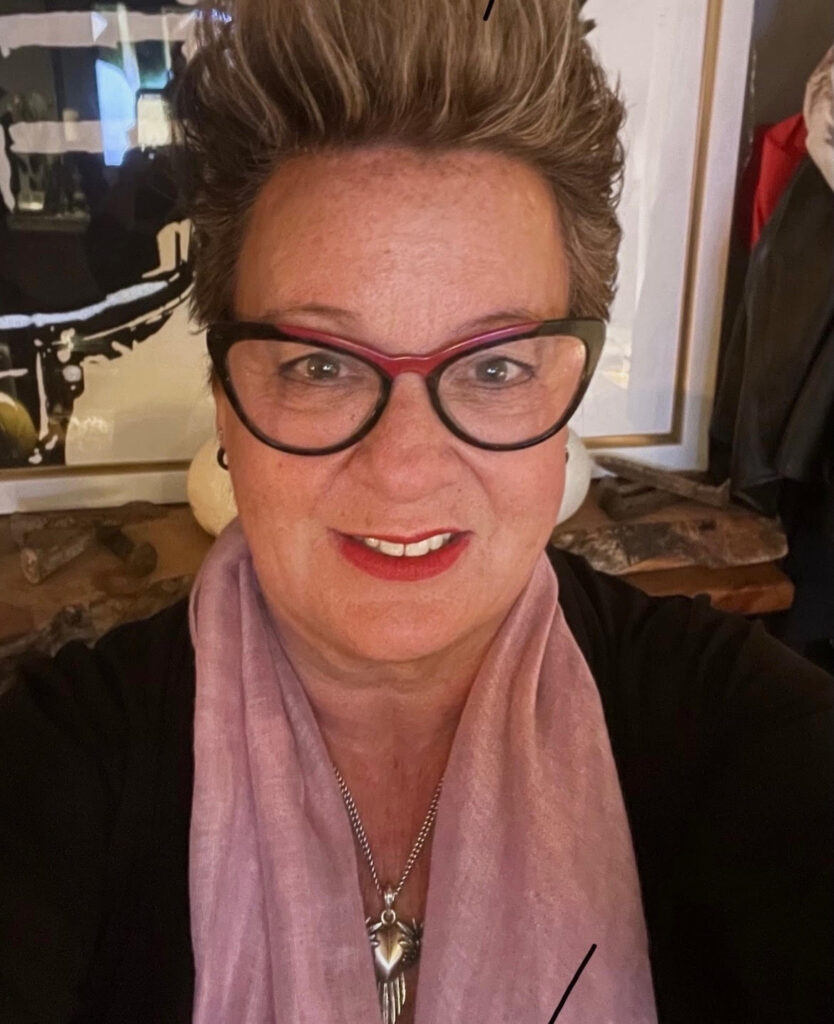
Denise Koster, LL.M, CTM, Lic. PI (She / Her), CEO Koster Consulting & Associates
Denise Koster is a licensed and insured private investigator and founder of Koster consulting & Associates (est. 1994), with over 30 years of experience in violence prevention, threat management, and complex investigations involving abuse, discrimination, harassment, and bullying.
Denise is trauma-informed and holds a Master of Laws (LL.M.) in Dispute Resolution from Osgoode Hall Law School, as well as a Certified Threat Manager (CTM) designation. She also serves as a Board Director for Elder Abuse Prevention Ontario, reflecting her long-standing commitment to addressing violence against older adults.
Currently, Denise is pursuing a Ph.D. in Gender, Feminist, and Women’s Studies at York University, where her research focuses on the intersectional dimensions of violence, power, age, and disability.
12:30 – 12:45 BREAK

12:45 – 1:20 pm
Sharing Information in Situations Involving Intimate Partner Violence: Guidance for Professionals
The presentation will cover jury recommendation 78 from the 2022 Culleton, Kuzyk, and Warmerdam Inquest, the IPC’s guidance, Sharing Information in Situations Involving Intimate Partner Violence: Guidance for Professionals, and dive into how Ontario’s privacy laws permit sharing personal information, without consent, when there’s a risk of serious harm to a person’s health or safety.
Speaker:
Karishma Firdausi, Policy Analyst, Policy Department, Information and Privacy Commissioner of Ontario
Karishma Firdausi is a Senior Policy Advisor at the Office of the Information and Privacy Commissioner of Ontario (IPC). Karishma is the Policy law enforcement lead under the IPC’s Strategic Priority, Next-Generation Law Enforcement, which champions Ontarians access and privacy rights by developing guardrails around the responsible adoption of next generation technologies and community-based approaches.
Karishma has held privacy roles with the Government of Canada and the Government of Ontario. She holds two degrees from the University of Toronto: a Master of Public Policy from the Munk School of Global Affairs and Public Policy and an Hon. Bachelor of Arts, specializing in Criminology and Socio-Legal Studies.

1:20 – 2:30 pm
Violence Link: Addressing the Intersection of Animal Abuse as it relates to intimate partners in aging populations
This presentation introduces the intersection of animal abuse, genderbased violence, elder abuse, and selfneglect in later life, with a focus on how concerns involving pets can reflect broader risks within the human–animal bond. It provides an overview of how harm to animals, changes in care, or shared vulnerability may signal coercive control, abuse, or unmet support needs affecting older adults. The session offers a foundational lens for understanding these connections and considers the implications for safety, wellbeing, and responses that take both older adults and their companion animals into account.
Speaker:
Dillon Dodson, RSW, MSW, Director, Social Work, Toronto Humane Society
Dillon is a registered social worker with nearly 20 years of professional experience in community mental health, supporting individuals experiencing homelessness and survivors of human trafficking and sexual exploitation. Her practice is grounded in ethical, traumainformed social work and focuses on integrating human and animal wellbeing within interdisciplinary settings. She holds a Bachelor of Social Work from McMaster University and a Master of Social Work from the University of Toronto, along with advanced certifications in trauma recovery, veterinary social work, and pet loss and bereavement. Dillon holds leadership roles within professional organizations, including serving as Vice President of the International Association of Veterinary Social Work, and has received provincial recognition for her contributions to the profession of social work. She is the Director of Social Work at Toronto Humane Society, where she leads embedded social work practice within the animal welfare and veterinary space. Dillon also created and continues to operate their crisis boarding/petsafe keeping program at Toronto Humane Society, which provides temporary foster care to over 150 animals each year and has supported more than 800 animals since its launch in 2020.

2:30 – 3:00 pm
The Wildflower Way
The Wildflower Way, a new resource from CNPEA developed with the support of WAGE Canada. The Wildflower Framework is a narrative change intervention that challenges dominant models in human services which devalue care and render aging invisible. It supports professionals to integrate services for older women who have experienced GBV into broader equity efforts through relational, trauma-and violence-informed practice. Wildflower invites transformation from within, growing equity-oriented care in the cracks of rigid systems.
The Wildflower Way is both a narrative strategy and a practical guide for nurturing growth, offering a path toward sustainability, healing, and genuine systemic change in human services.
Speaker:
Bénédicte Schoepflin, Executive Director, Canadian Network for the Prevention of Elder Abuse
Bénédicte has held the role of the Executive Director at CNPEA since 2018 after joining the organization in 2015. She provides national leadership on advancing a coordinated, rights-based approach to preventing and responding to elder abuse across Canada. Known for her strategic vision and collaborative leadership style, Bénédicte works to build bridges between governments, community organizations, professionals, and older adults to strengthen collective impact and drive systemic change.
Her background spans communications and non-profit leadership, including previous roles with the BC Law Institute and the Canadian Centre for Elder Law. Originally from Avignon, France, Bénédicte is now based in Vancouver, British Columbia.

3:00 – 3:30 pm
Not OK. Bringing Awareness to Older Women in Domestic Violence Shelter
The conversation will focus on the increasing trend of older women entering domestic violence shelters after experiencing decades of abuse. We will also discuss the systemic challenges and barriers within the service delivery sector—particularly in rural communities—that affect support for older women, as well as organizational adaptations within shelters to meet these growing needs.
The session will also include outcomes of the recently launched “Not ok. Campaign,” raising awareness about IPV in Perth County and our community’s response to high risk IPV cases and common risk assessment tool.
Speaker:
Donna Jean Forster, Executive Director, Optimism Place
Donna Jean is Executive Director of Optimism Place Women’s Shelter and Support Services in Stratford Ontario. She has been a career Executive Director in a variety of sectors over the last 30 years but for the last decade has been leading in the Violence Against Women sector. She champions collective impact as a multi-sector approach to creating change in our communities and deeply believes that we can make a difference if we work together.